
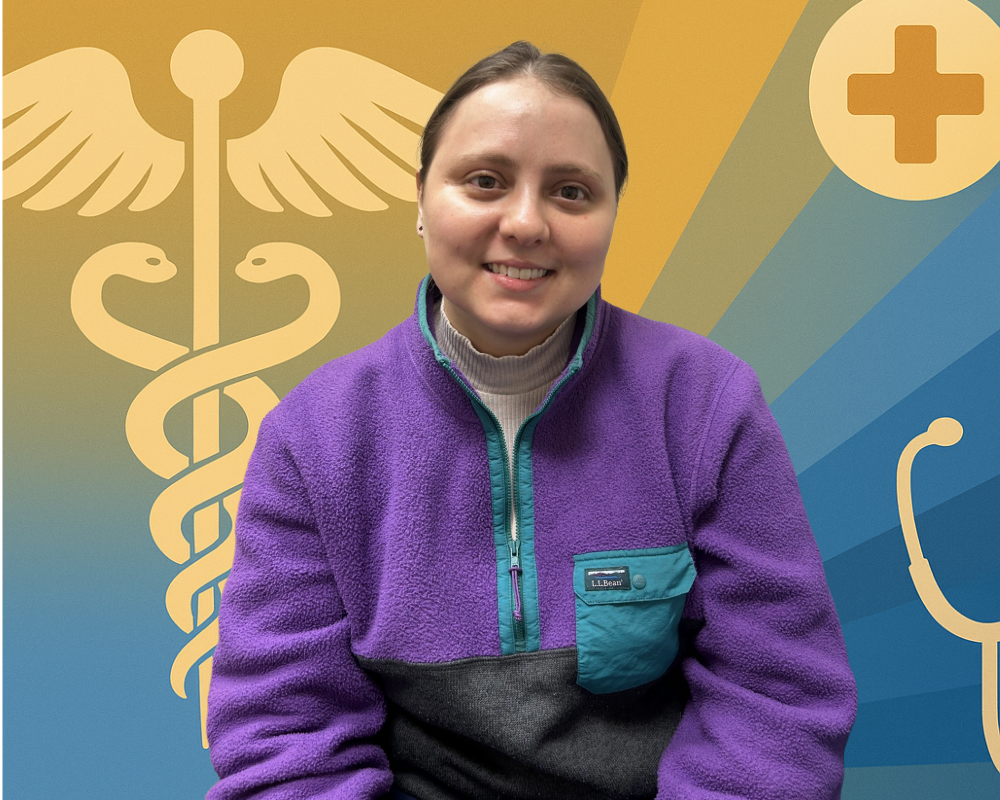
Sarah Brady came to the Clinic for a fourth-year elective that gave her the chance to work with the underserved—and to gain more experience in primary care.
She wanted to see what healthcare looks like when the patient isn’t just a diagnosis, and when “best practice” includes something you can’t chart in a note: dignity, prayer, and a team that refuses to look away.
Sarah is a fourth-year medical student at the University of Arizona College of Medicine – Phoenix. In her final year, students can choose electives that shape the kind of physician they’re becoming. Sarah chose an elective focused on working with the underserved, and it brought her to the Neighborhood Christian Clinic.
“I was really interested in working with that underserved population,” she shared. “And seeing how this type of clinic operated.”
It didn’t take long for her to see it.
A patient who couldn’t afford the “usual” solution
A few days into her rotation, a patient walked to the Clinic from nearby. She was clearly unwell and needed to get to the emergency room.
In most settings, the next step is straightforward: call an ambulance.
But Sarah noticed something many of us never have to think about. For this patient, the cost of an ambulance wasn’t a small inconvenience. It could be the difference between getting help and risking a bill she’d never be able to pay.
Sarah watched as the team immediately rallied around her.
Dr. Andrea. Dr. Paul. Cheryl. Clinicians and staff working together, not just to follow a protocol, but to solve a real-life problem in the context of a real-life story.
And then she shared a detail that says everything about the heart of this place.
Instead of defaulting to the “usual” solution, our team paid attention to her real-life situation and helped her get home safely so she could arrange a more affordable way to get to the emergency room—without losing sight of what mattered most: getting her the critical care she needed.
That is whole-person care. Not rushed. Not detached. Not “someone else will handle it.”
It is love with sleeves rolled up.
“Not just your diabetes or high blood pressure…”
Sarah hopes to practice OB/GYN, a field that blends clinic care and surgery and invites physicians into some of the most vulnerable moments of a person’s life.
What she’s learning at the Clinic is shaping how she wants to show up in those moments.
“I think what I’ll carry forward is thinking about the whole person when I’m seeing a patient,” she explained. “All the aspects of what is important to them in their life.”
She talked about something that has stood out to her again and again: the time the providers take.
Time to listen.
Time to look someone in the eye.
Time to ask about what’s happening at home, not just what’s happening in the body.
And time to pray.
“It’s been so wonderful taking that time… and praying with the patient,” Sarah said. “Just having that moment with them that’s very human.”
In a world where many patients feel like they’re being moved through an assembly line, Sarah is witnessing something different. A place where a visit is not ten minutes and a hurried exit, but often thirty minutes to an hour, where questions are welcomed and burdens are shared.
And where faith is not forced, but offered gently, naturally, and sincerely.
Why your support make this possible
When Sarah speaks about the Clinic, she doesn’t speak in vague terms. She speaks with clarity: your support becomes care in someone’s hands.
“I think you should support the Clinic because your support is a direct impact to people living right now,” she said.
People whose lives are not stable.
People who can’t just “schedule with their primary” or “follow up with a specialist” the way the rest of the world assumes.
People who come to the Clinic not only for medicine, but for a safe place to be seen, heard, and cared for.
“What other opportunity do you have… where it directly translates to medicine into somebody’s hands,” Sarah asked, “or like a prayer with the physician?”
And then she said something our team sees every day:
“This community here so desperately loves this place.”
A stronger foundation for every future doctor
Sarah believes every medical student should experience a setting like this, even if they don’t plan to work in an underserved community long-term.
Because it opens your eyes.
It teaches you to think beyond ideal scenarios and into real ones.
It forces the question: How do we provide excellent care when the patient can’t afford the options we take for granted?
It also grows compassion that lasts.
“Even if you weren’t serving with those people,” Sarah said, “it would help you recognize, well, maybe I should volunteer when I do have the time.”
That is how a new generation is shaped: one day, one patient, one unforgettable moment at a time.
Thank you, Sarah
Sarah came to learn. And she has.
But she has also given something to the Clinic in return: her presence, her attention, and her willingness to let this experience form her. We’re grateful for her heart, and we’re cheering her on as she steps toward a future in OB/GYN carrying what she’s learned here.
Whole-person care.
Creative compassion.
A faith that makes room for prayer in the exam room.
And the reminder that sometimes love looks like walking someone home so they can get the help they need.